Riding a bicycle looks like one skill, but it is really four, and each can be taught independently of the others:
- balance — the main thing, and the hardest;
- pedalling;
- getting on;
- getting off.
Below is the order that works, and the exercise for each part.
Balance
There are two techniques: a balance bike, or holding the child up. I prefer the first.
The balance bike
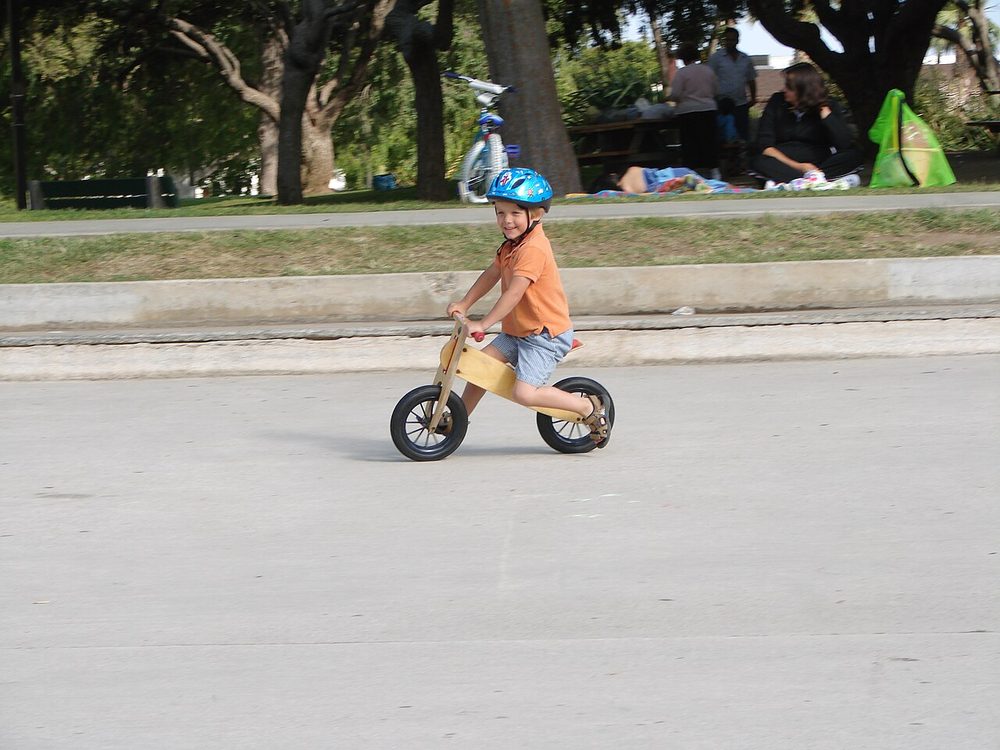
A balance bike is a bicycle without pedals. Photo: Jeremy Miles, CC BY-SA 2.0, Wikimedia Commons.
A real balance bike will do, and so will an ordinary bicycle turned into one: take the pedals off and drop the saddle far enough that the child stands on the ground with the bike between their legs and can sit on the saddle comfortably.
Why I choose this way:
- it asks nothing of the teacher while it is happening;
- the child learns to balance in whatever way suits them;
- holding a child properly demands a deep understanding of how a bicycle actually moves — which is rarer than it sounds, and without it you can easily teach the wrong thing.
The exercises, in order:
- Give the child the bike and simply walk up and down with it between their legs.
- Ask them to push off and coast a little.
- Separately from that, ride not in a straight line but in zigzags: find stones, sticks or cones, or draw marks in chalk, and ride around them — a figure of eight, for instance.
Balance is there once the coasting is confident: the child pushes off with one foot and rolls without putting the other one straight down; when the speed drops they push again rather than catching themselves with a foot.
Once the coasting is confident, spend another ten minutes on it. Some children need longer, but in my experience ten minutes has been enough for everyone.
Holding the child up
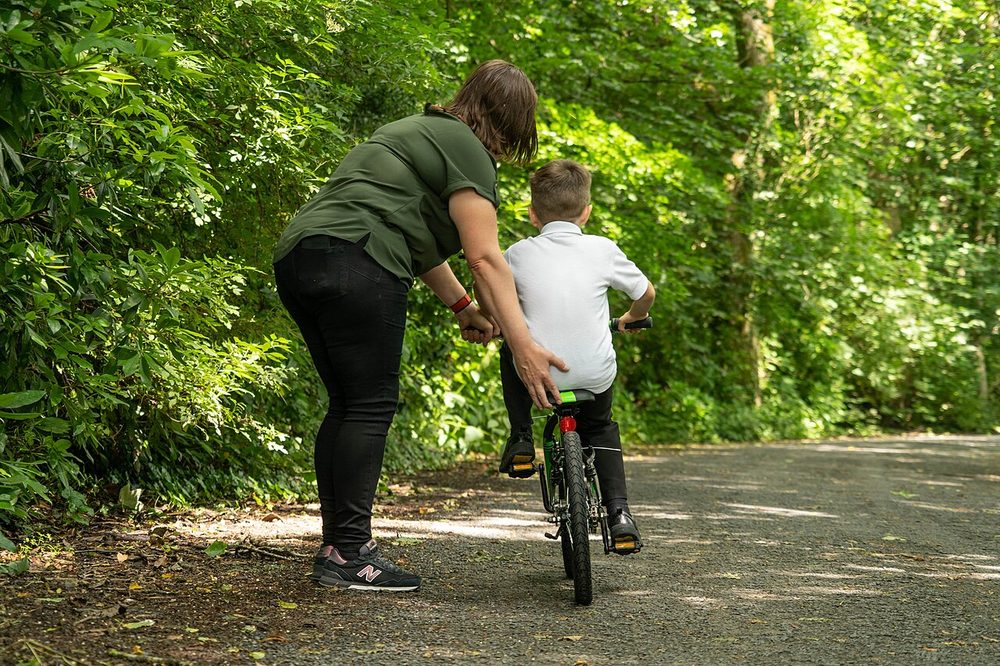
The second technique: an adult keeps the child from falling. Photo: Alextredz, CC BY-SA 4.0, Wikimedia Commons.
The child is kept from falling — with a scarf passed under the armpits, or by hand, steering and nudging them the right way. It works, but it needs an adult present throughout and that same understanding of the mechanics: nudge the wrong way and you cement the wrong movement.
Pedalling
Once the coasting holds, put the pedals back on. Leave the saddle low for now — raising it comes later.
A child who has turned pedals on a tricycle will most likely ride almost straight away. Without that, expect another ten minutes or so, though it usually takes a couple of minutes.
Pedalling technique is a bottomless subject, but for a beginner it is the easiest part of the skill.
Getting on, getting off, and saddle height
Riding is not the end of the lesson. A child, like an adult, needs the saddle at its working height: sitting square on the bike with the leg straight, the heel reaches the pedal at the bottom of the stroke. Raise it gradually, over several goes.
At that height the ground is out of reach from the saddle — hence two exercises first.
"The eagle" — learning which way to step off
The child rides and spreads their legs out to the sides (the saddle can be raised a little for this). As the speed drops the bike starts to lean one way — and the child learns to feel which way they are falling, and therefore which way to get off. Ten minutes is usually enough.
"The scooter" — learning to get on
The child stands on one pedal and rolls along, pushing with the other foot, as if on a scooter.
The same exercise teaches getting off, because that is how getting off really works: you stand on the pedal, rise off the saddle, shift your hips forward — in front of the saddle — and put the other foot on the ground. Getting on is the same thing in reverse: stand on the pedal, sit down on the saddle.
The exceptions are the extreme disciplines, bikes with a dropper post, and complete beginners on city bikes whose saddles are far too low.
The whole cycle
With all four parts in place, a ride looks like this — for a child and an adult alike:
- Scooter — stand on the pedal and get moving.
- Sit down on the saddle.
- Balance — held by steering into the fall. Probably the hardest thing to coordinate.
- Pedal.
- Stopping — feel which way you are falling, and scooter off the same way, in reverse.
That is the full cycle.
Comments (0)
No comments yet. Be the first!
Log in to leave a comment.